Hurt Locker
Saturday, April 12th, 2014
This week ends in approximately 22 minutes and counting.
This week ends in approximately 22 minutes and counting.

Michael Lewis’ new book on high-frequency trading, FLASH BOYS, is stunning. While free markets are based on the relatively fair flow of information between players, FLASH BOYS shows how profitable it can be to obfuscate and restrain that information.
Lewis describes one small group’s efforts to restore the fairness of information in the market. It’s a story that couldn’t happen in the traditional web of non-solicits and non-competes that decorate contracts like ornaments at Christmas. Thankfully the major actors in FLASH BOYS weren’t bound by them and worked to improve the market. Otherwise it would have been a short book - a few key people had an idea on how to restore fairness to the market but couldn’t.
These other, more common restrictions on the free flow of information within a market trouble me1. I understand and respect intellectual property but I cry foul when companies claim IP within their employees. It clearly hurts the market, but also wreaks havoc on the individuals caught up in it as well.
If a company can’t lazily leverage legalese for retention, they are forced to invest in their employees and in their culture. If each employee feels valued and empowered there is no incentive to leave the company to follow ideas and passions. Employers must make it absurd to consider leaving to compete against them. It’s a scenario where all parties benefit but it isn’t easy.
If you get the chance, FLASH BOYS is filled with insights like these and I can’t recommend it enough. A number of ideas have stuck with me from it and I continue to mull them over. You’re likely to see more of them within this space.
SP
particularly as I am currently bound by them. ↩
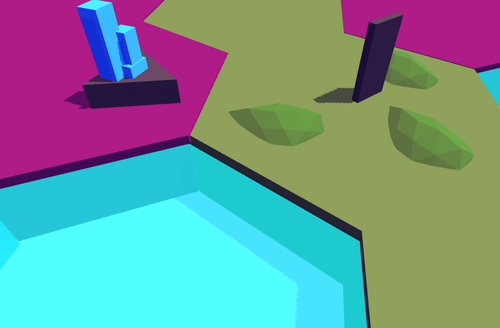
I’ve started work on another game, title officially TBD but let’s call it MO for now. The goal is to build an asynchronous multiplayer turn-based strategy game that takes about 30-60 turns with about 3-5 “actions” per turn.
I’m still fleshing out the mechanics, but I want to share my principles / constraints so far:
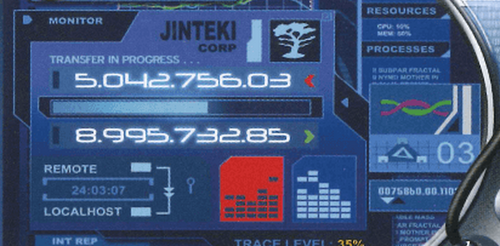
My megacorporation is on the wrong side of a wealthy Criminal playing a nasty Account Siphon. Not only would would that steal nearly half my credits, but it would boost his level of wealth from “Jay-Z” to “Scrooge McDuck.” A single trace is my only chance to stop him and we both know it. If the trace succeeds then he’s forced to end his run against my servers. My money would be safe, but for the trace to succeed I’d have to spend more credits then I stand to lose.
Netrunner overflows with these dilemmas. How much pain do I endure to guarantee my foe doesn’t profit? Did he know going into this that I could stop him at great cost, and just wants me to waste the credits? There’s rarely an answer that’s always correct regardless of the circumstances. While I try to win, I play to wrestle with these dilemmas of the moment.
A few people have gathered around the table. As I announce my decision about the trace, one of these watchers openly asks “WHAT! Are you INSANE?”
Hmmm.
“WHAT! Are you INSANE?”
Same sentiment but this is nearly five years earlier at approximately 1 A.M. I’m at the final table of a friendly poker tournament, playing against the final two others when I fold a hand that bring jeers, howls, and even a stern rebuke from the onlookers.
I smile nervously but say nothing. My hands tremble when I’m extremely excited - they’re my tell and so I hide them under the table. Moments later, the round ends, the crowd cheers, and this became a hand we still talk about today. It isn’t because another player was knocked out despite a good hand, but because I’d have been knocked out despite an amazing hand. I read the state of the entire table, figured the leader had a truly phenomenal hand, and played accordingly.
Folding may be losing but that play still feels better than winning. In poker I maybe get one or two of those moments every few games, moments when you see through the Matrix and really are playing the person across the table from you rather than just the cards in your hand. It’s rare though. I spent a lot of time in poker chasing that dragon.
Netrunner is full of those moments. With so many public, discrete bits of information, every turn matters and there are continuous revelations about the state of the game and players. There’s enough mechanical complexity to make a puzzle to ponder, but still enough ambiguity to play the players and not just the mechanics.
There are many reasons I am having a torrid love affair with Netrunner lately but this may be chief amongst them.
“WHAT! Are you INSANE?”
Back to the dystopian future of Netrunner. I do nothing. I let the trace fail, presenting no challenge to the runner whatsoever and leaving the door wide open to the Account Siphon. I could have shut it down entirely for just one more credit than I lose to it. Instead I left our corporate bank account numbers and a nice glass of tea in our reception area.
Like me, the runner now faces a choice: continue and steal my money, or end the run now and reap no rewards or consequences. It looks like a trap. It looks like a bluff. It looks like an amateur mistake.
I think to myself “Please don’t end the run. Please steal my credits.” I remain silent, doing my best to act annoyed and resigned. I hide my hands beneath the table - they’re my tell.
Thankfully, my opponent’s greed gets the better of him. He finishes the run and takes his ten credits. He also suffers the side effects of an Account Siphon. The runner is automatically tagged, an effect that basically means my giant, powerful megacorporation knows where this little hacker lives.
I use this tag to kill him immediately on the next turn. The game ends and he is a corpse, albeit a fabulously rich one.
I don’t particularly care about the win. That’s not what I’ll remember. I’ll remember the pivotal moment of two decisions - my decision not to resist, and the runner’s decision to continue. Netrunner provides so many of these choices and opportunities to react that I can’t help but love the game even when I’m on the losing side of these decisions.
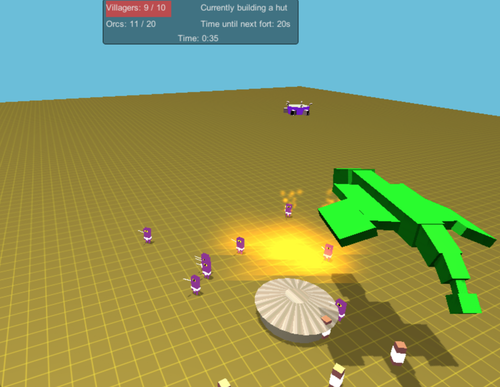
My goal was to finish Our Man Dragon in February, and I did so with 52 minutes to spare!
Obviously it’s still rough around the edges and isn’t the most attractive thing, but I completed all the major features I planned.
My goal in finishing this was to learn the ropes in each major feature of making a game. Short of sound effects, visuals, and controller input, I did just that.
In order to make a complete game I am proud of, it isn’t enough to have interesting gameplay. I need to at least hack together compelling music or visuals. If I am ever to make something I am proud of, I can probably afford a professional for one of those two, but not both.
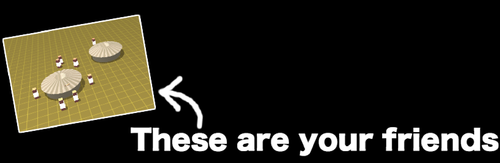
It’s been awhile since I’ve provided an update on Our Man Dragon, so allow me to rectify that.
It’s not uncommon for software projects to spend just as much time going from “start” to “basically done” as they do to go from “basically done” to “done.” Our Man Dragon is no different - the basic gameplay was hammered out in a day while I am on month two of “finishing up.”
However, it’s dramatically more challenging to stay motivated towards the end of this game than the many non-game software projects in my career. The crux is that all of my work is now towards making sure a new player knows what they are supposed to do as well as I do. This means GUIs, intro screens, etc.
It feels tedious, but this is important work. Even though this is not a particularly fun game, I want it to be a complete game so that I have experienced each part of releasing a game. This has always been a learning project so I am determined to finish this before moving on to something more interesting.
For the curious, you can track my remaining work on the Our Man Dragon Trello board.
SP
Here’s roughly where I start in determining how much I like a game:
(average number of hard decisions per minute)/(number of pages in rulebook * number of times that players ask "Whose turn is it right now?”)
This metric favors a few types of games quite strongly:
There’s also a number of mechanics and genres that do extremely poorly. Random, chaotic games like Munchkin and Fluxx tend to provide few hard decisions. Interaction-light Euro-style board games like Agricola and Puerto Rico often result in an extraordinary number of “Whose turn is it?” questions because of the analysis required of players. Most wargames fail spectacularly because of their many rules and long turns.
If you have a similar rule of thumb or common theme in your gaming interests, I’d love to hear it.
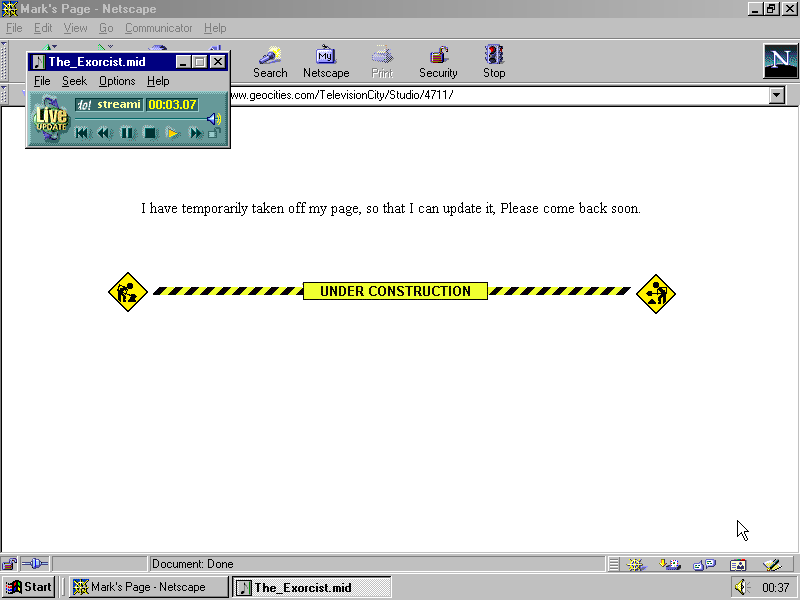
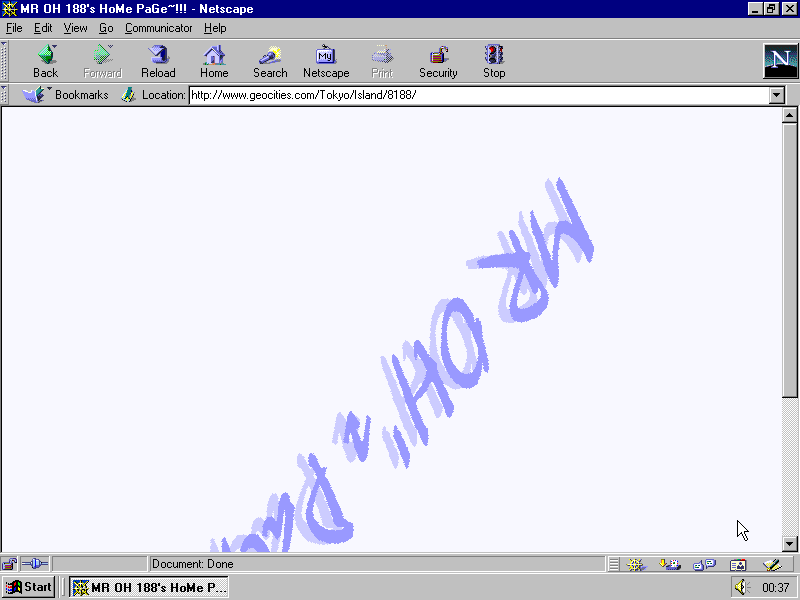
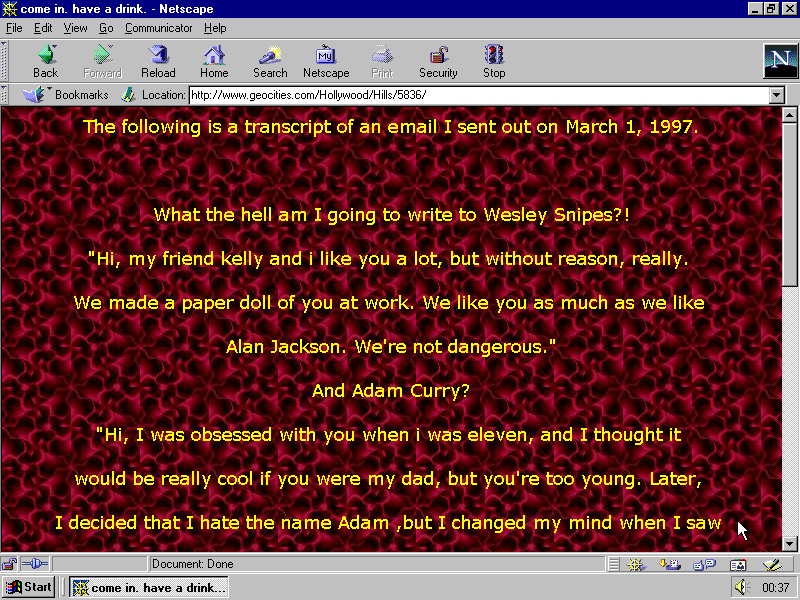
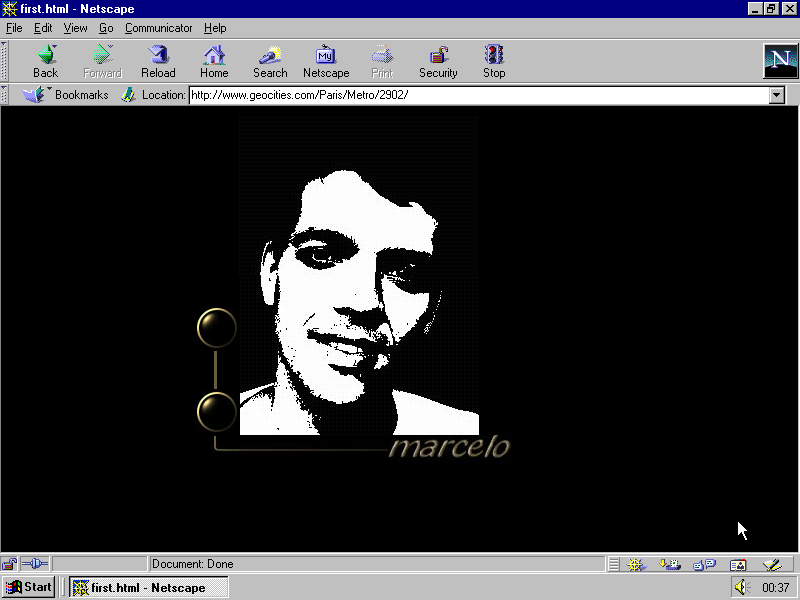
The Tumblr One Terabyte of Kilobyte Age is my new obsession. The Tumblr is a snapshot of archived Geocities pages in chronological order. I’ve posted some of the more interesting below.
The blog of the research project taking these screenshots is fascinating as well. It captures a time when hordes of new users were trying to create on the internet. What strikes me is not how many are clearly unfamiliar with the “how” of creating their own homepages, but also with the “why”. This archive is littered with people writing statements to the effect of “I don’t know why I am doing this and don’t have anything to say, but…”
Definitely check it out.
“Worker Placement” in board gaming dates back to roughly the turn of the century, but recently there has been a second wave of games experimenting within the mechanic. Keyflower is the most ambitious of these that I have played. While I found the whole lesser than the sum of its parts, it has some rather clever ideas that I want to celebrate.
Keyflower is a game of building villages using workers to acquire and use a number of different building tiles. Your workers are both what you spend to activate buildings (placing them on a tile) as well as acquire buildings (placing them next to a tile). Each building is unique and provides its own unique, mathy perk.
It’s a clever game, but is burdensome to play. The sheer number of options demands careful analysis at all times, but the high degree of randomness in the draw of tiles and the play of others means it is challenging to most to do most of that analysis in advance of your turn.
That’s all nerd talk for saying it’s slow. Very slow. “People leaving the table entirely between their turns” slow. The slogan (slowgan?) of this game should be “Whose turn is it again?”
HOWEVER, that doesn’t make the game any less clever, and I want to call out a couple of the most cleverest bits.
In the game’s final round, you are buying tiles not because they do anything (they largely don’t), but because they establish victory conditions for you alone if you win the bid. This itself is immensely clever, but it gets better.
Each player is dealt a number of these tiles at the start of the game. Before the final round, they choose how many to make available for bidding. If I see Fred has a ton of ore on his tiles, then I may choose to keep the “5 VP for each 3 Resources” tile off the board at the end. However, perhaps I’ve also invested heavily in resources as well, at which point I have a tough (but unfortunately math-intense) decision ahead of me.
This ability to change the rules of victory is extremely clever, something I haven’t seen before in a game. Hidden information in games isn’t particularly new, but the uncertainty involved in it with Keyflower turns this concept on its head. It was absolutely thrilling to see this play out.
Workers come in four different colors. In of themselves, the colors are meaningless. A yellow worker can mine ore just as well as a red or green one. BUT WAIT! As with most things in Keyflower, there’s a twist.
Once I bid on a tile with a particular color, only workers of that color can be used to outbid me. Similarly, when I activate a tile, only workers of that same color can re-activate it. So while these workers have no absolute difference between them, they take on stark relative differences between each other.
It’s a very interesting way to play with the idea of currency. It’s as if I could place the first bid on an eBay auction in Confederate scrip and block anyone else from bidding against me. I’ve never seen a game that divorced the concept of currencies from cost in such a way.
Keyflower isn’t my favorite game and it isn’t one I will bring to the table often. Don’t think you shouldn’t try it though. It’s like a David Lynch movie - I’m glad I saw it even if I didn’t enjoy watching it.
Anyone truly interested in new board gaming concepts should play through a game of Keyflower - there’s several more I am sure I’ve missed. It may not be the greatest, but I’ll be damned if I didn’t end the game with my head spinning of ways those mechanics could be reused and reimagined.